
Lymphoedema and chronic wounds — nursing care measures
Safe compression therapy, lymphorrhoea management and timely recognition of deterioration
Jelena Kevrić · 16 min read
English translation of the original Croatian article; the Croatian version is authoritative. Educational content only — not individual diagnosis or treatment.
Lymphoedema and chronic wounds require a combined assessment of the skin, oedema, circulation and the patient's abilities. This article brings together lymphorrhoea management, safe compression therapy, a measurable nursing care plan and clear criteria for medical assessment.
Key points
- Lymphoedema and chronic wounds are assessed together: a dressing manages exudate but does not, on its own, address impaired lymphatic drainage.
- A sudden or unexplained change in swelling should not automatically be attributed to known lymphoedema; first check for warning signs.
- Compression therapy requires an individualised plan, assessment of the circulation, an appropriate system and a trained practitioner.
- Monitor the skin, lymphorrhoea, exudate, pain, function and comparable measurements; reduced limb circumference is not the only evidence of success.
- Patients need to know when to seek assessment, what to do if a compression device causes pain and whom to contact if the agreed contact is unavailable.
Before changing the dressing again, check why it is wet
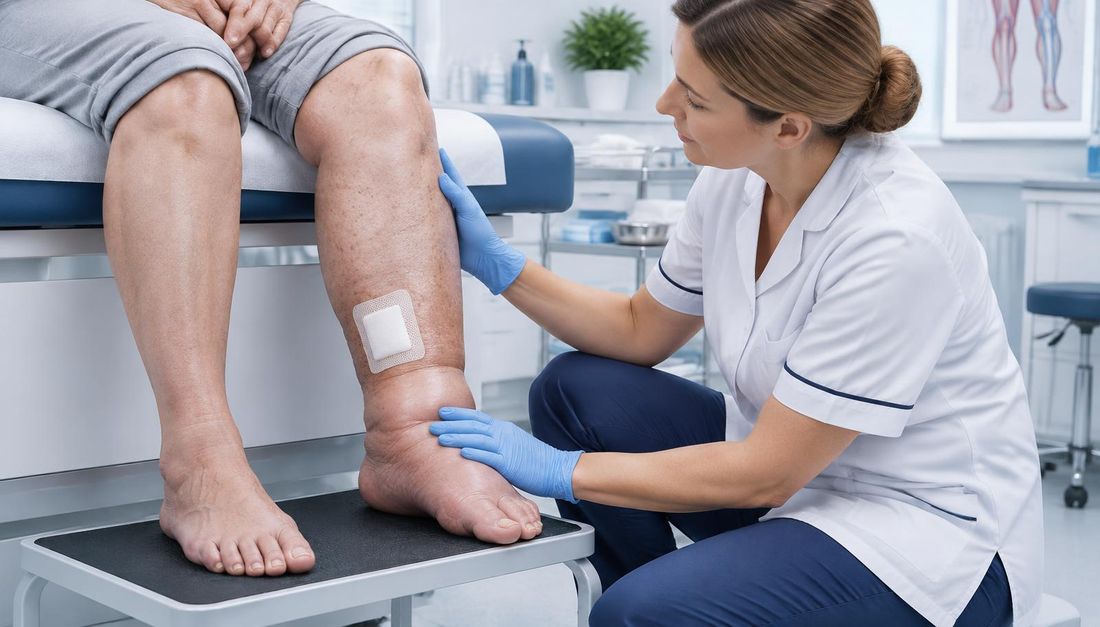
The dressing is saturated again, but the wound has not enlarged. Before reaching for a thicker dressing, establish whether fluid is coming from the wound, through damaged periwound skin or from several sites on the swollen limb. Repeated dressing changes without assessing oedema may leave the underlying cause unaddressed and further damage the skin.
Lymphoedema develops when the lymphatic system cannot drain an adequate amount of fluid from the tissues. It may be primary or develop following damage to lymphatic pathways, for example after surgery or radiotherapy. Venous disease, immobility and other conditions may contribute to a complex presentation of chronic oedema. The appearance of a swollen limb alone does not establish the cause or the suitability of treatment.
The 2023 International Society of Lymphology consensus describes comprehensive treatment combining skin care, compression therapy, movement and, where indicated, manual lymphatic drainage. The aim is to control the condition and preserve function, not to promise a permanent cure with a single intervention. This article concerns adults with a lower-limb wound; oedema of the trunk, genitalia or head and neck requires a separate specialist plan.

Distinguish stable lymphoedema from changes requiring assessment
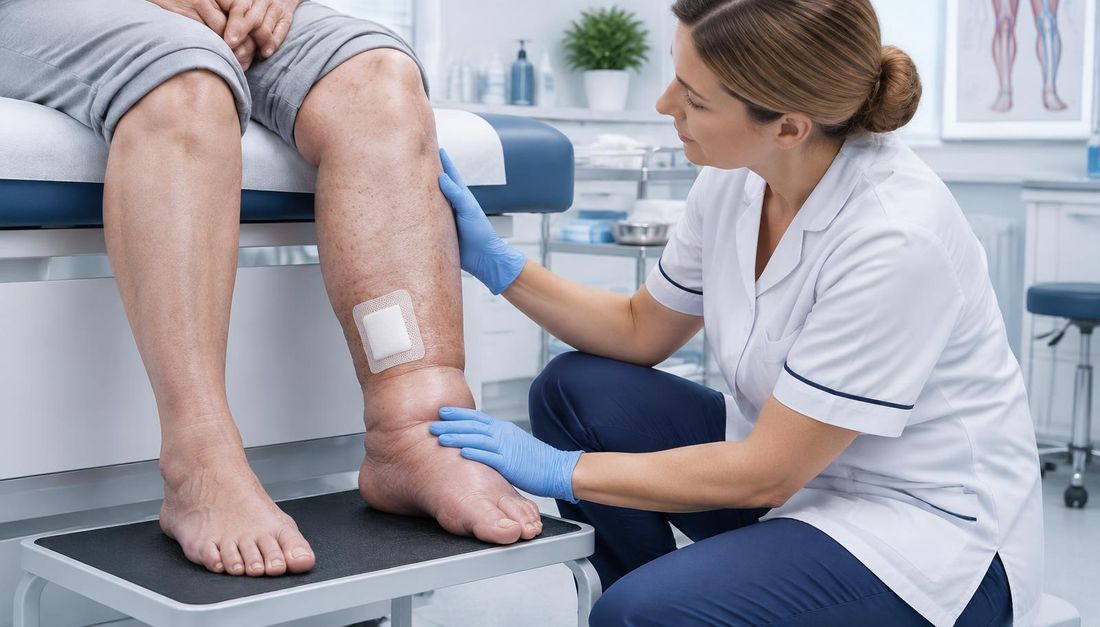
Establish when the swelling began, how it changes throughout the day, any history of infection, surgery or radiotherapy, and whether venous, arterial, cardiac or renal disease is present. Prescribed medicines, new pain, breathlessness, chills, reduced mobility and any recent interruption to treatment are important. Sudden deterioration may have another cause, including deep vein thrombosis or worsening heart failure.
Examine the entire limb: the toes and interdigital spaces, foot, heel, skin folds and the area above the upper edge of the compression device. Record pitting, skin thickening and fissures, maceration, warmth, tenderness and the distribution of erythema. On more darkly pigmented skin, compare colour changes with the usual appearance and assess temperature and tenderness. A photograph, where permitted, supplements but does not replace the description.
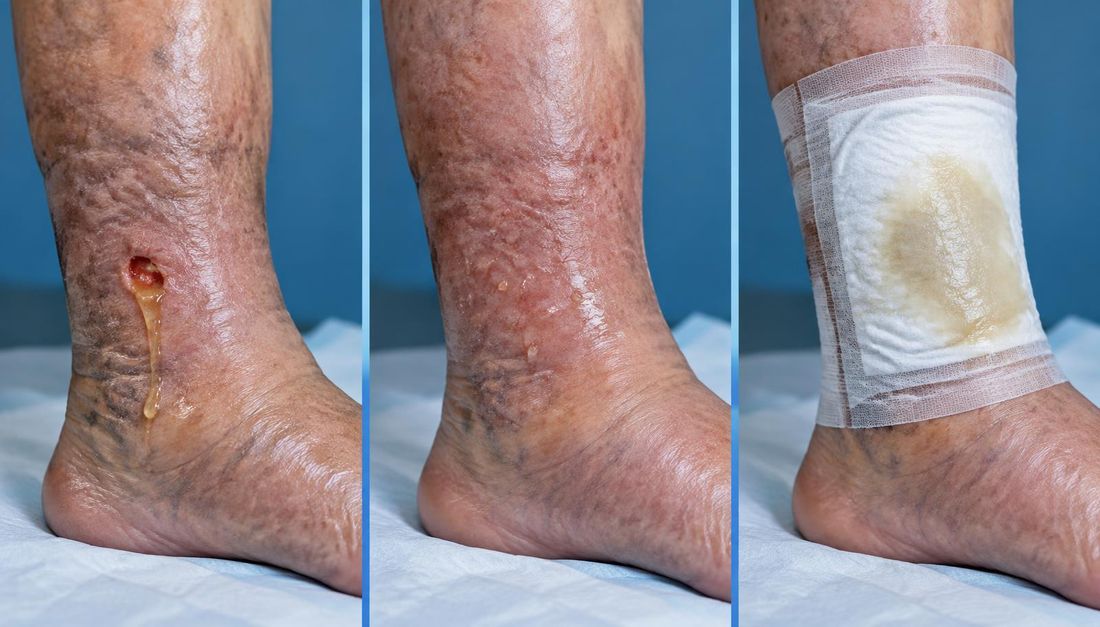
Lymphorrhoea is the leakage of lymphatic fluid through the skin, often as small droplets. Persistent moisture damages the skin. Clear or straw-coloured fluid is not, in itself, pus, but lymphorrhoea does not exclude coexisting infection. Document the site of leakage, the appearance of the fluid and the frequency of dressing strike-through.
How to obtain comparable assessment findings
| What to monitor | Conditions for comparison | What the result does not demonstrate |
|---|---|---|
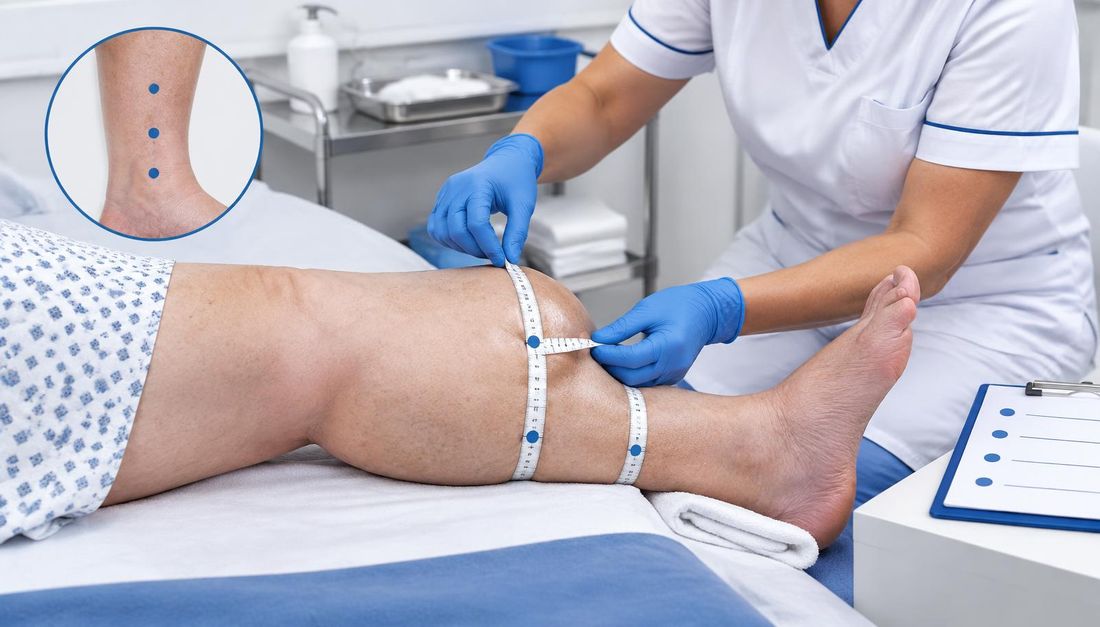
| Limb circumference | Use a non-stretch tape at the same anatomical landmarks, in the same position, at approximately the same time of day and at the same interval relative to removal of the compression device. | A single measurement does not represent the volume of the entire limb; a small difference may be a measurement error. |
| Wound and periwound skin | Use the same wound identifier and measurement method; describe lymphorrhoea, maceration and new damage separately. | A dry outer dressing does not prove that the skin beneath is undamaged. |
| Exudate and dressing changes | Record the dressing type, application time, saturation and number of unplanned changes within a defined period. | Fewer changes do not indicate success if a wet dressing is left in place too long. |
| Pain and function | Use the same scale and assessment conditions; assess rest, walking and procedures separately, alongside the patient's description. | Reduced pain does not exclude sensory impairment or pressure damage. |
Tablicu je na užim zaslonima moguće pomicati vodoravno.
Attach a map of the measurement sites to the record. Do not compare measurements taken over a bandage with those taken on bare skin; in bilateral oedema, the other leg is not necessarily a healthy control. If measurement is not feasible, document the limitation rather than an apparently precise number. A new symptom takes priority over a scheduled measurement.
Combine skin protection, dressings and oedema control
Skin care includes gentle cleansing, careful drying, particularly between the toes, and an appropriate preparation for dry, intact skin. Do not leave thick layers of the preparation in moist interdigital spaces. Report fissures and suspected fungal infection for targeted assessment. Do not wait for a small fissure to become a wound.
Choose a dressing that protects the skin under compression
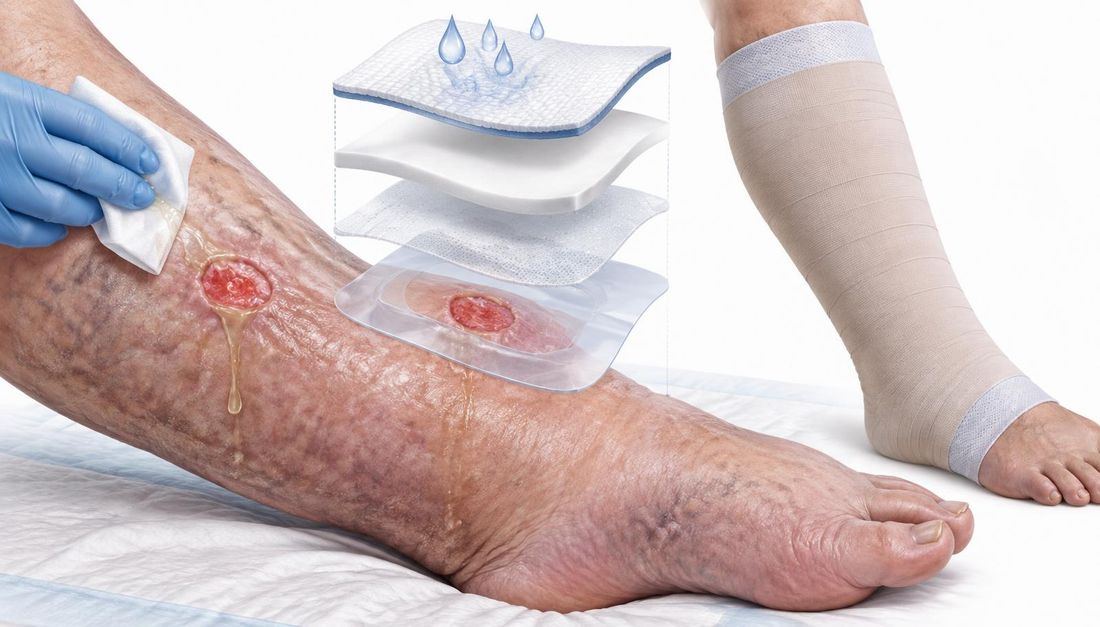
Cleanse the wound according to the plan. Select a non-adherent contact layer and an absorbent material that retains fluid under the planned compression therapy. Protect the periwound skin and check the combined dressing and padding for localised bulges, folds or pressure. Do not wrap the limb in impermeable household material to stop leakage.
The 2024 practical consensus on compression garments and wraps describes lymphorrhoea as a problem requiring simultaneous local care and oedema control. A saturated dressing or displaced system requires reassessment, not simply the addition of an outer layer. The frequency of changes is determined by fluid volume, skin condition, material properties and the plan; one interval does not suit everyone.
Provide compression therapy only according to an individualised plan
Arterial supply and clinical suitability must be assessed before compression therapy. A warm limb or a palpable pulse alone is insufficient to guide the decision. If findings are unreliable or the condition has changed, further professional assessment is required before starting or intensifying treatment. Another person's bandage or a device of the same size is not a safe substitute.
| Situation | Clinical decision at the point of care | What not to conclude |
|---|---|---|
| Arterial disease or uncertain limb perfusion | A professional decision is required on the permissible system and monitoring. | A single normal superficial sign is insufficient to justify standard compression pressure. |
| Heart failure | Distinguish a stable condition from deterioration; seek assessment for new breathlessness. | Not all heart failure permanently contraindicates compression, and not all swelling is due solely to lymphoedema. |
| New unilateral swelling and pain | Arrange urgent assessment of the cause; do not massage or independently intensify therapy. | Suspected thrombosis is not the same as medically supervised treatment of confirmed thrombosis. |
| New pressure marks, digging in, slippage or swelling above the edge | Check fit, pressure distribution and limb coverage. | Tightening further is not a universal solution. |
Tablicu je na užim zaslonima moguće pomicati vodoravno.
The international consensus on compression risks states that stable heart failure and treated deep vein thrombosis do not automatically contraindicate all compression therapy. The decision depends on the clinical condition, the selected system and monitoring. In decompensated heart failure, therapy must not be started or intensified without medical assessment.
Check safety immediately after application
After application, check pain, colour, warmth, sensation and toe movement, the edges of the system, footwear fit and the ability to walk safely. New pain, numbness or colour changes are not normal signs of adjustment. A device causing these symptoms should be removed, or its pressure released, within the practitioner's competence, with immediate contact with a specialist. Suspected compromised circulation requires immediate action.
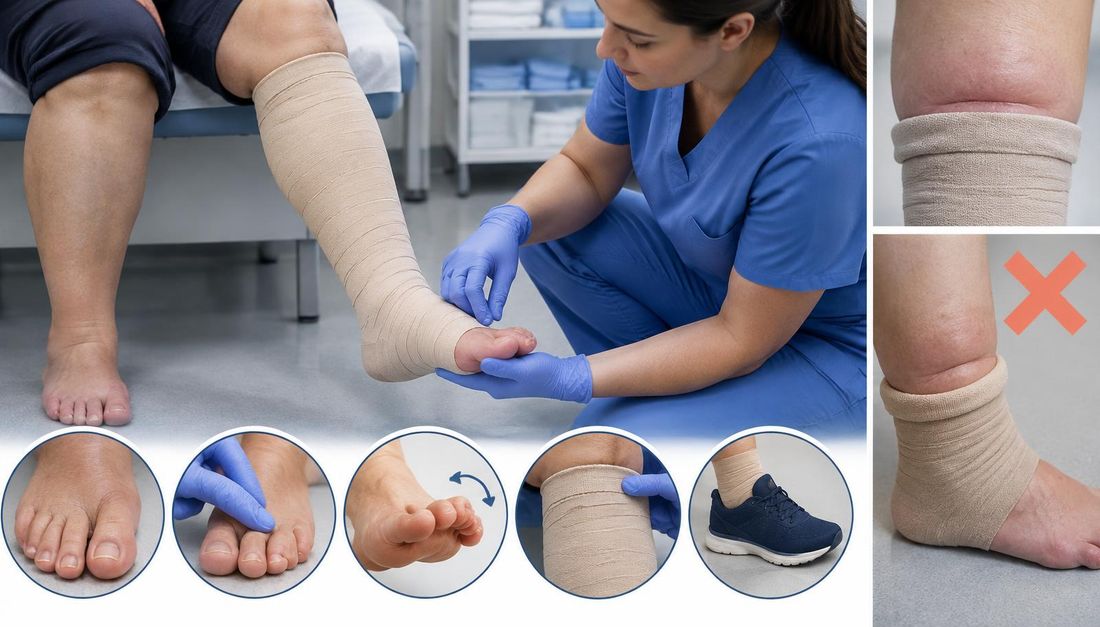
Movement and positioning are adapted to the wound, exercise tolerance and falls risk. Agreed foot exercises and walking stimulate the muscle pump, while a painful wound may require adjustment of weight-bearing. Leg elevation must not cause new pain or breathlessness. Manual lymphatic drainage is not vigorous massage of a swollen limb; it is performed by a trained practitioner when indicated.
Razina dokazaInternational consensus documents, professional guidelines and good practice recommendations; certainty of evidence varies between interventions.International Society of Lymphology 2023; Rabe et al. 2020; British Lymphology Society and Wounds UK 2024; British Lymphology Society and Lymphoedema Support Network 2025.These documents support an assessment and safety framework but do not demonstrate equal effectiveness for every material or technique. The 2024 document on compression garments and wraps received industry support. International sources do not determine professional competence in Croatia; this depends on education, authorisation, training and local protocols.
Link the goal to skin condition and everyday function
The following fictional example concerns a hospital inpatient with confirmed lymphoedema, coexisting venous disease and a previously approved compression plan. Plan identifiers, personnel and deadlines are included only to illustrate the structure of the record; they are neither a universal protocol nor real data. The 48-hour period is used to assess the initial response, not to promise healing.
Lymphorrhoea and skin damage on the left lower leg
- Problem
- Impaired skin integrity with lymphorrhoea, chronic wound R1 measuring 2.0 × 1.0 cm, periwound maceration and pain of 4/10 at rest. There were two unplanned dressing changes due to fluid strike-through during the previous 24 hours.
- Cilj
- Within 48 hours, with planned dressing changes, there will have been no fluid strike-through or new skin damage during the final 24 hours; pain at rest will be no greater than 2/10. The patient will state two reasons for seeking help earlier and demonstrate how to call for assistance.
- Intervencije
- The named nurse provides local care and applies the prescribed system, checks tolerance immediately and 15 minutes after application, and reviews at the agreed time; checks are brought forward for any new symptom or strike-through.
- Morning and evening reviews have a named practitioner and a deadline. Exudate, skin condition, pain, sensation, movement and system fit are documented.
- If the practitioner is unavailable, the shift coordinator secures a named replacement before the deadline, with confirmed acceptance of responsibility. A wet dressing is changed according to the findings and is not left in place to achieve the goal.
- If strike-through or new damage occurs, request a review of the local care plan before the next application. Suspected infection or a vascular problem is communicated to the doctor immediately, with a response deadline determined by urgency.
- Evaluacija
- Individual reviews assess each episode, and the named nurse evaluates the overall goal after 48 hours using all records. An unmet criterion requires a review of implementation and causes, not automatic intensification of compression or attribution of failure to the patient.
When continuing routine care is no longer safe
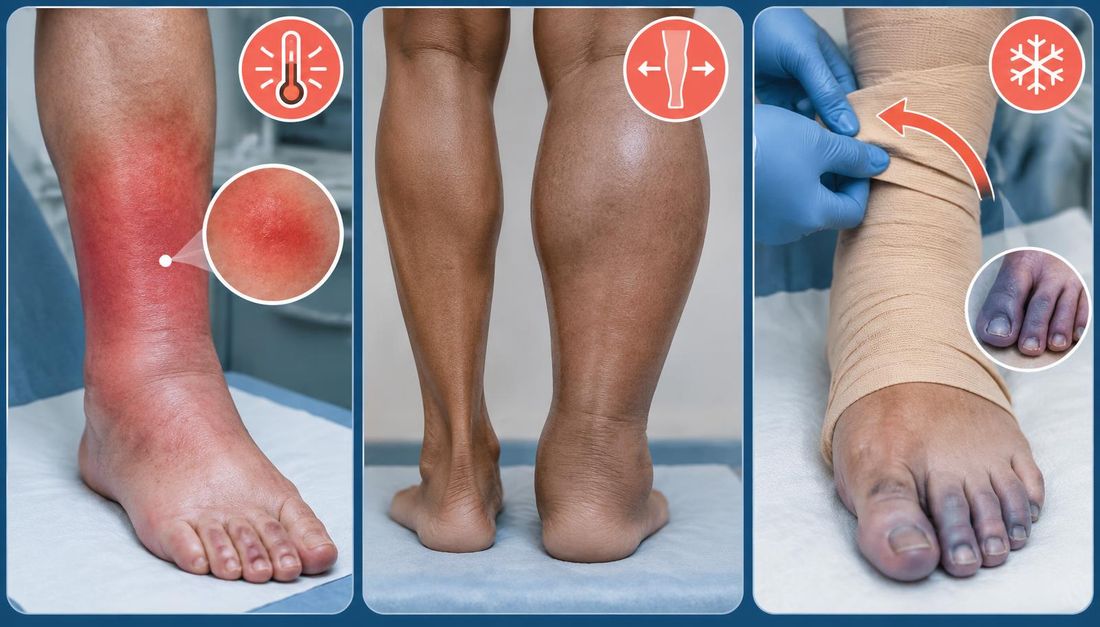
New warmth, tenderness, erythema or a sudden increase in swelling requires contact with a doctor for same-day assessment. Cellulitis, a bacterial infection of the skin and subcutaneous tissue, can occur without fever. Do not wait for a routine review or a swab result when clinical findings require prompt treatment.
If the usual compression device causes pain during an acute infection, remove it temporarily. Agree on reintroduction as soon as it is tolerated, checking the fit. This is not advice to discontinue all compression therapy permanently. Routine manual lymphatic drainage is not performed during an acute infection, and the movement plan is adapted to the patient's condition.
New unilateral painful swelling requires urgent assessment for possible deep vein thrombosis. Sudden breathlessness or chest pain accompanying these findings requires emergency assessment for possible pulmonary embolism.
Stable lymphorrhoea requires timely adjustment
Stable lymphorrhoea without new warning signs does not automatically require an emergency response, but it does require timely adjustment of care. Agree on a specific review time when the condition allows. Rapid saturation, inability to protect the skin or deterioration must not wait until that appointment.
Clearly define who changes the plan and what is documented
The 2024 Act Amending the Nursing Act links the scope of professional competence to education. For a complex procedure, verify the practitioner's specific training, role and working conditions. An instruction does not compensate for a missing skill.
Limits of professional competence
Samostalne intervencije
- Within the scope of education, current authorisation to practise, training and assigned role: collect information, recognise changes, provide care according to the plan, monitor the response and educate the patient.
Postupci po nalogu ili u suradnji s timom
- Within the team, establish the cause of oedema, assess arterial supply and comorbidities, select or modify the compression regimen, and provide specialised manual lymphatic drainage and prescribed treatment; each procedure is performed by a practitioner trained to carry it out.
Outside independent scope of practice without appropriate authorisation or an instruction
- Independently initiate or permanently change medicines, intensify the compression regimen or attribute sudden swelling to known lymphoedema without assessment. Immediately unsafe treatment is stopped while appropriate help is sought.
Handing over a task requires confirmed acceptance, a deadline and a replacement if the arrangement fails. The following fictional record illustrates the structure; codes and initials are not real data or a substitute for local, version-controlled instructions.
Findings after the first application and follow-up review
Nedostatan zapis
Leg swollen and leaking. Dressing changed and compression applied. Review as required.
Primjer primjerenog zapisa
18 September 2026 at 09:00; educational case patient B-19. Wound R1 on the medial aspect of the left lower leg measures 2.0 × 1.0 cm, with periwound maceration extending up to 0.5 cm and clear wound exudate accompanied by droplets leaking through the periwound skin. No pus, new warmth or spreading erythema. Pain at rest 4/10; foot warm, usual colour, toe sensation and movement preserved. Two unplanned dressing changes in the previous 24 hours. Circumferences 30.0/37.0/43.0 cm at marked levels 10/20/30 cm above the tip of the medial malleolus, measured with a non-stretch tape, without a bandage, lying down after 15 minutes of rest; measurement-site map attached. Before the procedure, the doctor reviewed the available arterial and cardiorespiratory findings and confirmed the prescribed system. A trained nurse cleansed the wound, protected the periwound skin and applied a non-adherent absorbent dressing, padding and the prescribed short-stretch system. Immediately and 15 minutes afterwards, there was no new pain, numbness or change in colour, warmth or toe movement; pain 3/10. At 13:00, no strike-through or slippage, pain 2/10, distal findings unchanged. The dressing was not removed, so the skin beneath it was not assessed at that time. The next review was agreed, with an earlier check for new symptoms or saturation and a named replacement if the practitioner is unavailable. In their own words, the patient identified new pain and numbness as reasons to call immediately. An actual record includes full identities, exact versions of instructions and authentication.
Ensure the patient has a workable plan
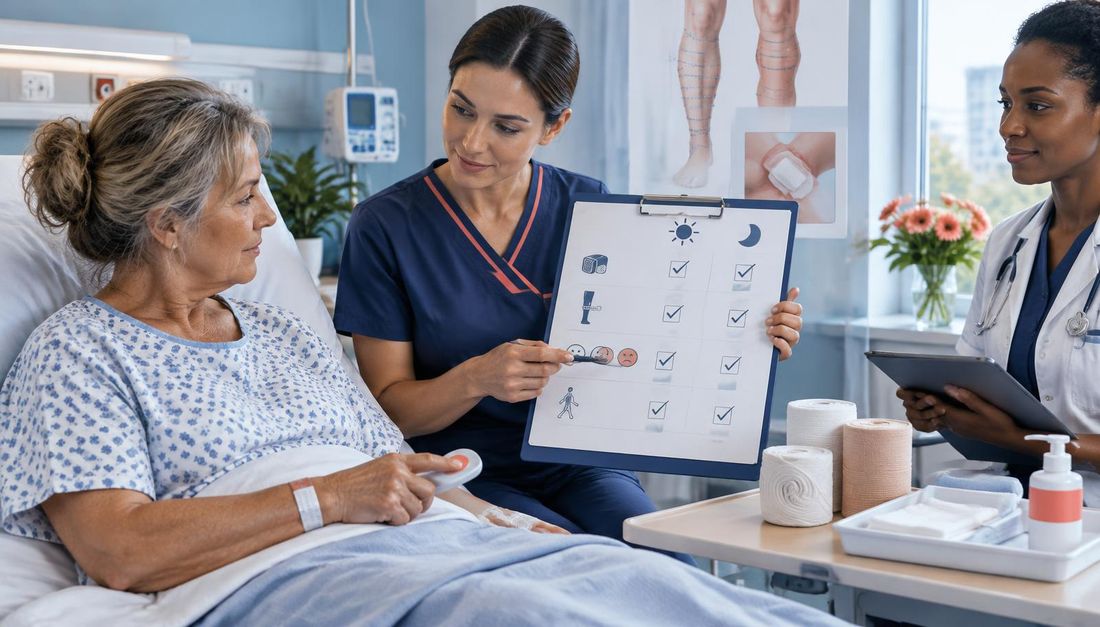
Check whether the patient can reach their foot, put on the compression device, walk in suitable footwear and obtain supplies. Arrange assistance and demonstrate the use of donning aids. Involve a family member with the patient's consent. Ask the patient to repeat the plan in their own words; clarify any uncertainty by explaining again.
Do not advise additional fluid restriction or changes to diuretics solely because of lymphoedema. Diuretics have a limited role in lymphoedema itself, but coexisting cardiac or renal disease may require their use. Patients must not stop prescribed treatment independently.
Frequently asked questions
Česta pitanja
Should a swab be taken every time a dressing is wet?
No. First assess the source of the fluid and clinical signs of infection. Take a sample when indicated; do not delay urgent assessment while waiting for a swab.
Can the bandage be tightened further if the swelling does not decrease?
Not without reviewing the plan. The cause may be poor fit, another condition or a measurement error, and additional pressure may damage the skin or nerves or compromise circulation.
Is leg elevation enough?
It may help when tolerated, but it does not replace individualised treatment. New pain or breathlessness requires a change of position and assessment.
Does care stop when the wound closes?
No. Continue skin care, adapted movement, use of the prescribed device and follow-up reviews. The maintenance plan should reduce the risk of recurrent swelling and damage.
Izvori
References
Popis izvora korištenih pri pisanju ovog članka.
1. izvor: Executive Committee of the International Society of Lymphology. The Diagnosis and Treatment of Peripheral Lymphedema: 2023 Consensus Document of the International Society of Lymphology. Lymphology. 2023;56(4):133–151.
Otvori izvor (vanjska poveznica)2. izvor: Lymphoedema Support Network. Practical Assessment of Lymphoedema. Pristupljeno 18. rujna 2026.
Otvori izvor (vanjska poveznica)3. izvor: McCann M. Lymphorrhoea. LymphLine. Lymphoedema Support Network; Summer 2014.
Otvori izvor (vanjska poveznica)4. izvor: Lymphoedema Support Network. Just Diagnosed? Pristupljeno 18. rujna 2026.
Otvori izvor (vanjska poveznica)5. izvor: Fletcher J, Borthwick Y, Elwell R, Hill T, Mason W, Rich A, Sneddon M, Whitaker J. Practical issues in applying compression garments and wraps for management of lymphoedema. Wounds UK; 2024.
Otvori izvor (vanjska poveznica)6. izvor: Rabe E, Partsch H, Morrison N i sur. Risks and contraindications of medical compression treatment – A critical reappraisal. An international consensus statement. Phlebology. 2020;35(7):447–460.
DOI: 10.1177/0268355520909066
Otvori izvor (vanjska poveznica)7. izvor: Cancer Research UK. Compression treatment for lymphoedema. Revidirano 26. svibnja 2026.; pristupljeno 18. rujna 2026.
Otvori izvor (vanjska poveznica)8. izvor: National Health Service. Lymphoedema — Treatment. Pristupljeno 18. rujna 2026.
Otvori izvor (vanjska poveznica)9. izvor: British Lymphology Society, Lymphoedema Support Network. Guidelines on the Management of Cellulitis in Lymphoedema. August 2025.
Otvori izvor (vanjska poveznica)10. izvor: National Health Service. DVT (deep vein thrombosis). Pristupljeno 18. rujna 2026.
Otvori izvor (vanjska poveznica)11. izvor: Hrvatski sabor. Zakon o izmjenama i dopunama Zakona o sestrinstvu. Narodne novine 123/2024.
Otvori izvor (vanjska poveznica)