
Wound-related pain: assessment, prevention and holistic management
From identifying pain mechanisms and systematic assessment to preventing procedural pain, treating the underlying cause and preserving quality of life.
Oliver Jurić · 15 min read
English translation of the original Croatian article; the Croatian version is authoritative. Educational content only — not individual diagnosis or treatment.
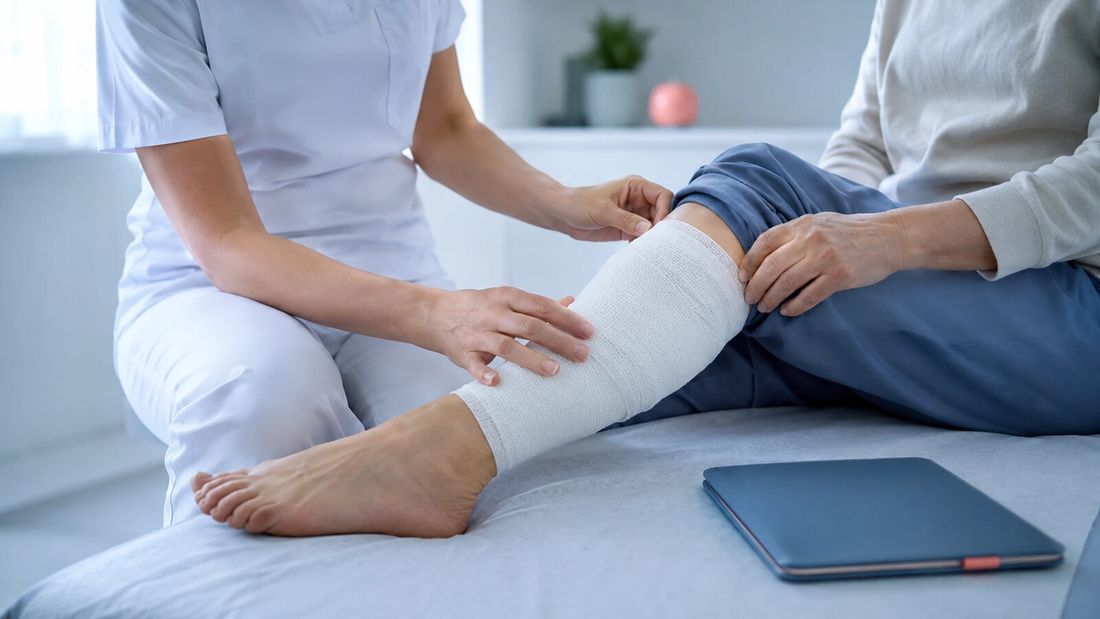
Wound-related pain is not simply an intensity score from 0 to 10, but a complex experience influenced simultaneously by tissue damage, inflammation, ischaemia, the nervous system, treatment procedures, and psychological and social factors. Effective management combines identification of the pain mechanism, treatment of the underlying cause of the wound, atraumatic local care, appropriate analgesia, education and a biopsychosocial approach.
Ključne točke
- Pain should be assessed in every person with a chronic wound, even when they do not report it spontaneously.
- A single numerical scale describes intensity but does not reveal the cause, mechanism or impact of pain on daily life.
- Nociceptive, inflammatory, ischaemic and neuropathic components may coexist.
- It is particularly important to distinguish background, incident, anticipatory and procedural pain.
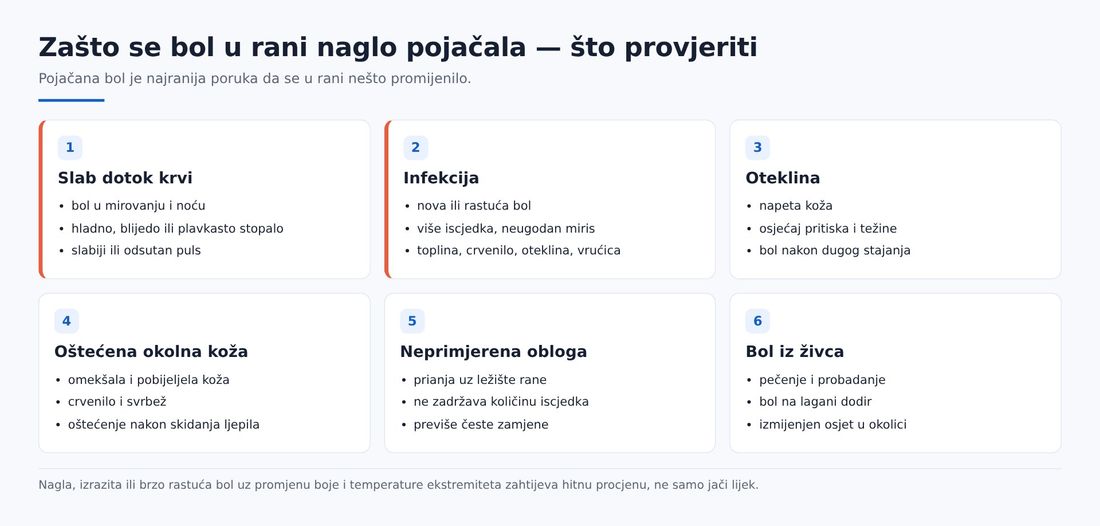
- New or suddenly worsening pain requires renewed investigation of the cause, including infection, ischaemia, pressure, oedema, periwound skin trauma and treatment complications.
- The aim is not simply to reduce the pain score, but to improve sleep, mobility, adherence, function and quality of life.
Wound-related pain is not a single symptom
The International Association for the Study of Pain (IASP) defines pain as a sensory and emotional experience associated with actual or potential tissue damage. Pain is therefore always what the patient describes, not what is visible in the wound.
In chronic wounds, pain arises from tissue damage, inflammation, infection, oedema, ischaemia or damage to the periwound skin, while repeated procedures add their own stimulus. Prolonged stimulation alters sensitivity, so that even light touch becomes painful.
Clinically, the most useful distinction is between background pain, which is present between procedures, and pain associated with a procedure or activity. These are accompanied by incident pain during movement and compression, and anticipatory pain: fear before a procedure that itself intensifies the sensation.
| Type or mechanism of pain | Typical clinical clue | What needs to be clarified |
|---|---|---|
| Nociceptive and inflammatory | tenderness, throbbing, pain on touch or during wound care | tissue trauma, inflammation, oedema, dermatitis, infection |
| Ischaemic | deep pain, rest pain, possible association with limb position | arterial perfusion and vascular compromise |
| Neuropathic | burning, electric shocks, searing pain, allodynia, altered sensation | nerve injury, diabetic or other neuropathy |
| Procedural | occurs or increases during dressing changes, cleansing or debridement | dressing adherence, procedural technique, pre-procedure analgesia plan |
| Incident | occurs during movement, pressure or repositioning | mechanical loading, compression, footwear, position, oedema |
| Background | present between procedures | wound aetiology, infection, ischaemia, neuropathy, inflammation and comorbidities |
Tablicu je na užim zaslonima moguće pomicati vodoravno.
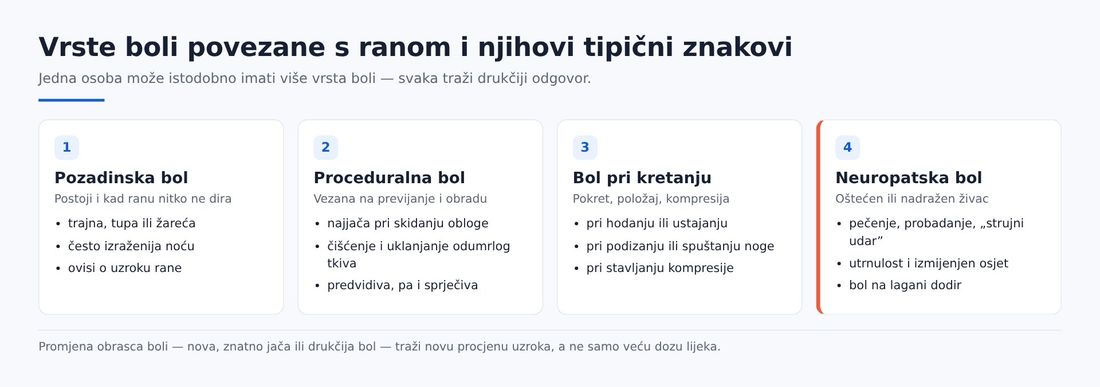

The most important guide is a change in the pain pattern: pain that has been stable for months and pain that suddenly worsens over hours or days are not the same clinical problem.
Pain assessment: a score from 0 to 10 is only the beginning
The European Wound Management Association (EWMA) review concludes that no single scale is suitable for every person and every chronic wound. Unidimensional tools measure intensity well, but do not reveal the pain mechanism or its impact on daily life.
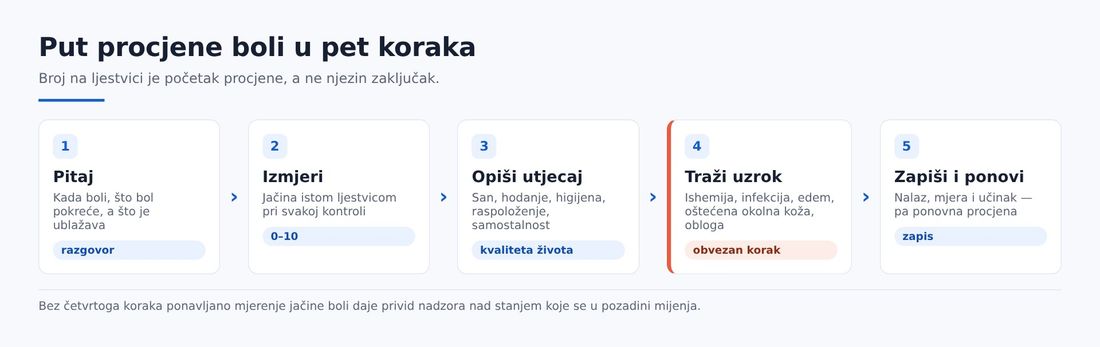
The discussion can be guided by the OPQRST framework (onset, provocation and palliation, quality, radiation, severity and timing of pain), with mandatory questions about pain during dressing changes, night-time pain and what relieves it.
For someone who can communicate reliably, a numerical rating scale from 0 to 10 is practical for repeated measurements; verbal rating and visual analogue scales are equally valid alternatives. The key is to use the same tool at every review.
In chronic pain, its effect on the patient's life is equally important: whether it disrupts sleep, walking, personal hygiene, work, relationships, mood or the ability to follow treatment. Without this information, the effect of treatment cannot be assessed.
People with cognitive impairment require an adapted approach. EWMA cites the Pain Assessment in Advanced Dementia (PAINAD) scale, which is based on observation of panting, vocalisation, facial expression, body tension and consolability.
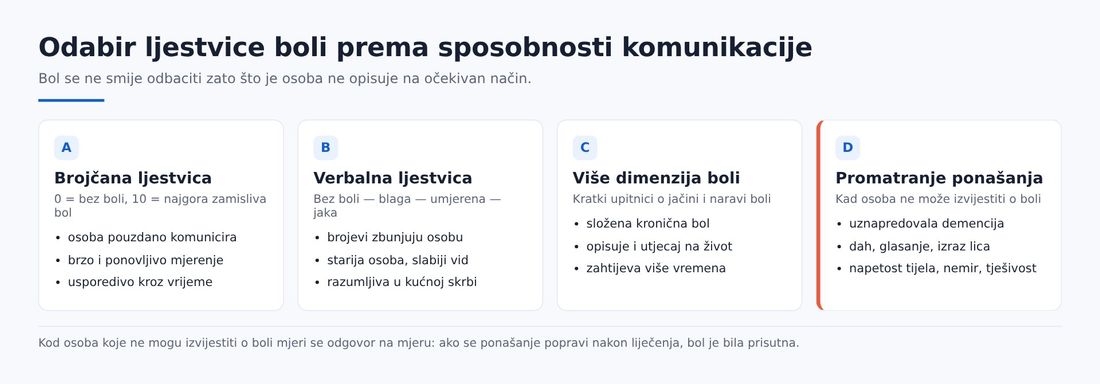
| Clinical question | Appropriate approach |
|---|---|
| How much does it hurt now? | numerical, visual or verbal scale |
| How does pain change during dressing changes? | the same scale before, during and after the procedure |
| What is the pain like, and how does it affect daily life? | multidimensional instrument and discussion |
| Is there a neuropathic component? | symptom description, neurological examination and screening tool |
| The person cannot reliably verbalise pain | observational instrument adapted to cognitive status |
Tablicu je na užim zaslonima moguće pomicati vodoravno.
Differential diagnosis: what pain may reveal about the wound
The most important question is often not how much it hurts, but why. Measuring intensity without interpreting the cause creates an illusion of control.
Ischaemic pain can easily be mistaken for ‘usual wound pain’. In arterial disease, pain should be considered alongside skin temperature and colour, capillary refill, pulses and limb position; night-time rest pain requires expedited vascular assessment.
Infection and inflammation also increase pain. New or progressive pain, particularly with changes in exudate, local warmth, oedema, erythema or general condition, requires assessment of the depth and severity of infection rather than an automatic increase in analgesia.
A neuropathic component is more likely when there is burning, electric shock-like pain, prickling, numbness, altered sensation or pain triggered by light touch, which is common in diabetes and long-standing wounds.
The team's own procedures should also be reviewed: a solution that is too cold, aggressive cleansing, an adherent dressing, pulling on adhesive, maceration, dermatitis, an overtight bandage and incorrectly applied compression. These are causes the team can correct immediately.
Procedural pain: a successful dressing change begins before dressing removal
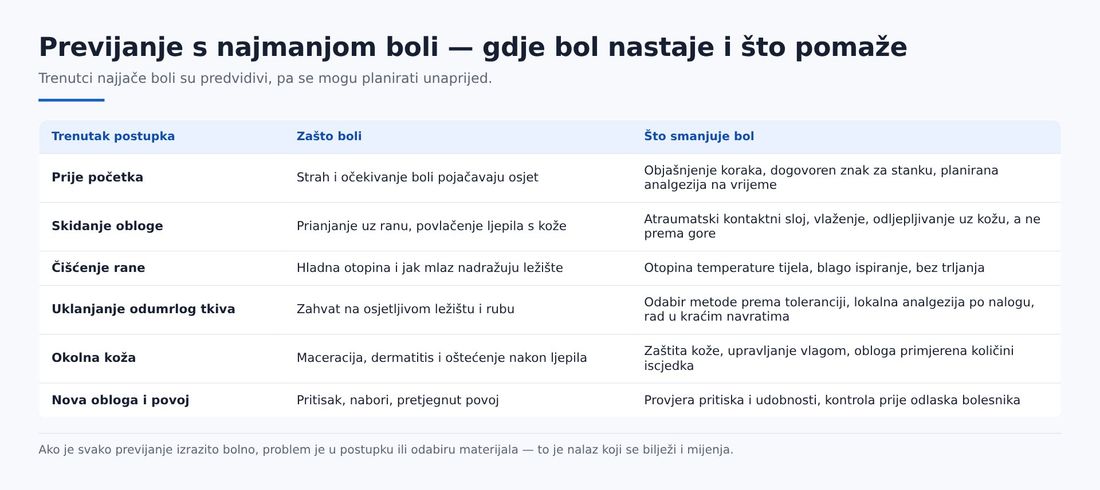
Pain during dressing changes is not an inevitable price of good wound care. If every procedure is very painful, identify where the pain occurs: during dressing removal, cleansing, removal of devitalised tissue or bandage application.
Dressing adherence is an important mechanism of procedural pain, and the available evidence supports atraumatic contact layers and removal techniques that do not damage the wound bed or periwound skin.
When painful debridement is planned, pain should be assessed in advance, not when the patient can no longer tolerate the procedure. Systematic reviews included by EWMA show that topical preparations may help some patients, but the evidence base remains heterogeneous, so the decision follows clinical assessment and a doctor's prescription.
The choice of debridement method affects procedural tolerance; EWMA describes evidence for methods in which pain was no greater than with comparator techniques. Procedural pain is therefore a legitimate criterion when selecting a method.
Before the procedure, explain what will happen, agree on a stop signal and allow enough time for the planned analgesia to take effect. The predictability of the procedure itself reduces pain.
Postupak
Minimising pain during dressing changes: sequence of care
- 1. korak: Before starting, check the record: which step was most painful last time, and what helped?
- 2. korak: Explain the procedure and agree on a signal for a short pause; this agreement must be respected.
- 3. korak: Administer the planned analgesia as prescribed, early enough for it to take effect.
- 4. korak: Remove the dressing slowly, moistening it when necessary and supporting the skin rather than pulling.
- 5. korak: Irrigate with a solution at body temperature, avoiding a forceful jet and rubbing of the wound bed.
- 6. korak: Remove devitalised tissue in shorter stages, assessing tolerance between them.
- 7. korak: Protect the periwound skin and select a dressing according to the amount of exudate.
- 8. korak: Apply the bandage and compression without creases, and check comfort before the person stands up.
- 9. korak: Document the most painful step and the measure that helped.
Holistic management: treating the cause, the wound and the person
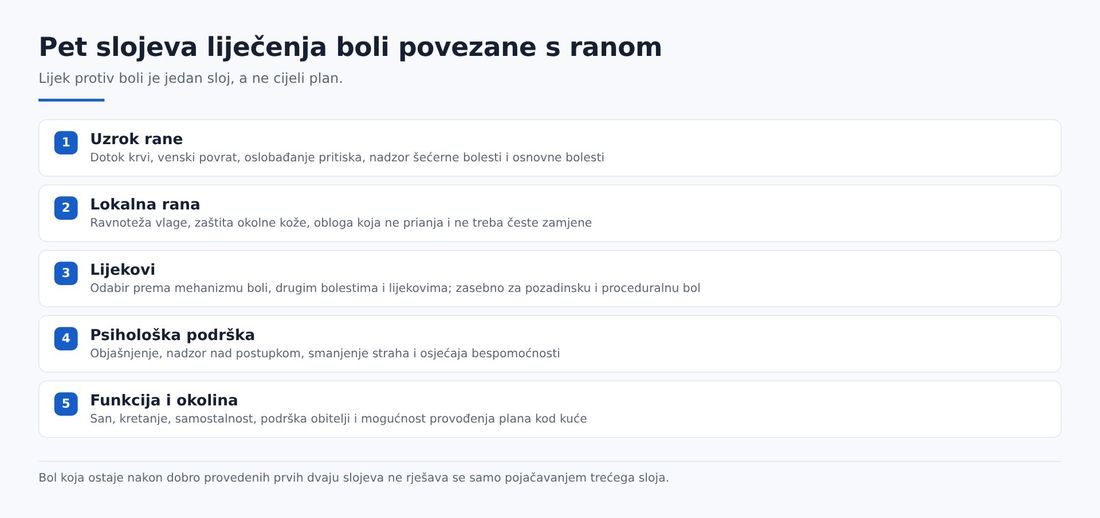
The first layer of treatment addresses aetiology. An ischaemic wound is not treated with analgesics without vascular assessment, a venous ulcer requires treatment of venous disease and appropriate compression, and a pressure ulcer requires pressure relief.
The second layer is local wound care: moisture balance, periwound skin protection and less unnecessary trauma. The dressing should retain exudate, avoid adhering to the wound bed and not require more frequent changes than necessary.
The third layer is a pharmacological strategy tailored to the pain mechanism, comorbidities and other medicines, and the expected duration of symptoms. Background and procedural pain are planned for separately, and the decision is made by a doctor.
The fourth layer is psychological. Expectation of pain, fear, catastrophising, anxiety and avoidance of activity intensify pain perception and make treatment more difficult to follow, so explanation and control over the procedure have a measurable effect.
The fifth layer is social and functional. Pain that disrupts sleep, isolates a person from others or prevents walking may be a greater problem than the wound area, and without family support and home care the plan is often not feasible.
Non-pharmacological measures that do not replace treatment of the cause
Non-pharmacological measures have a clear but limited role: they reduce tension and fear and improve procedural tolerance. They are most useful when agreed in advance and used alongside effective treatment of the underlying cause of the wound, rather than as a substitute for analgesia.
- Explanation of the steps and a pre-agreed signal for a pause.
- Comfortable positioning and limb support before starting.
- Short breaks rather than one long procedure.
- Directing attention through conversation during the procedure.
- Scheduling dressing changes for the time of day when pain is least.
Assessment and management algorithm
Postupak
Wound-related pain: the clinical pathway
- 1. korak: Ask every person with a wound about pain, even if they do not report it spontaneously.
- 2. korak: Identify the type of pain: background, incident, anticipatory, procedural or mixed.
- 3. korak: For new or progressive pain, first reassess the underlying cause of the wound and possible complications.
- 4. korak: If there are signs of ischaemia, prioritise vascular assessment; otherwise assess infection, oedema, pressure and local factors.
- 5. korak: Assess for a neuropathic component when there is burning, electric shock-like pain, pain on light touch or altered sensation.
- 6. korak: Select one scale and use it consistently; for complex chronic pain, add an assessment of its impact on daily life.
- 7. korak: If pain is greatest during dressing changes, analyse every step of the procedure and the local care strategy.
- 8. korak: For a predictably painful procedure, plan analgesia and communication before starting; stop the procedure when pain becomes unacceptable.
- 9. korak: Alongside pain-intensity targets, set functional goals: sleep, mobility and adherence to treatment.
- 10. korak: If pain remains uncontrolled after the cause has been addressed and appropriate basic treatment provided, request a multidisciplinary assessment.
Monitoring outcomes and when to change the plan
A pain management plan is only as useful as its measurable effect. At every review, document pain intensity using the same scale, separately at rest and during dressing changes, together with several functional indicators: sleep, completion of dressing changes, walking and independence.
| Time frame | Finding | Decision |
|---|---|---|
| Within 24 hours | sudden or rapidly increasing pain with a cold, pale or bluish limb, or with signs of spreading infection and deterioration in general condition | expedited clinical and vascular assessment before any adjustment of analgesia |
| Within 72 hours | new persistent pain during compression, a sudden increase in pain during dressing changes, new damage to or maceration of the periwound skin | reassessment of the local care strategy, dressing and dressing-change technique |
| Within 7 days | pain continues to interrupt sleep or prevents completion of dressing changes | adjustment of the pharmacological strategy according to the pain mechanism and reassessment of the cause |
| Within 4 weeks | no improvement in pain or healing despite correct implementation of the plan | multidisciplinary or specialist assessment rather than repetition of the same strategy |
Tablicu je na užim zaslonima moguće pomicati vodoravno.
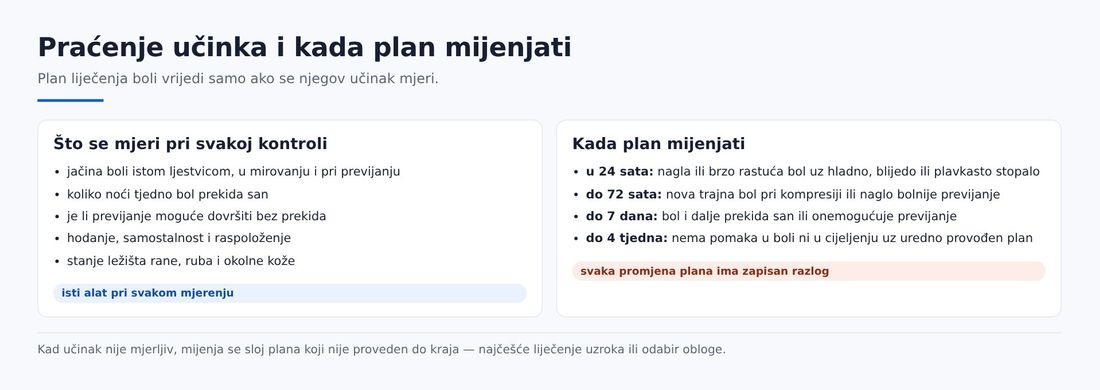
The aim of monitoring is not simply a lower score. If pain intensity has decreased but the person still cannot sleep or walk and avoids dressing changes, the plan is not successful. The layer that has not been fully implemented needs to be addressed, most often treatment of the cause or dressing selection.
Common mistakes in managing wound-related pain
- Pain is not assessed when the patient does not report it spontaneously.
- The scale is changed between reviews, making results non-comparable.
- A sudden increase in pain is managed solely by increasing the dose, without investigating the cause.
- Procedural pain is not documented, so dressing changes remain equally painful.
- The periwound skin, dressing and dressing-change technique are not checked.
- The neuropathic component is not recognised.
- Ischaemic pain is interpreted as ‘usual wound pain’, and vascular assessment is delayed.
Checklist for reviewing a painful wound
- Pain has been assessed and documented separately at rest and during dressing changes.
- The same scale has been used as at the previous review.
- The pain pattern and relieving factors have been documented.
- Reversible causes have been checked: blood supply, infection, oedema, pressure and periwound skin.
- A possible neuropathic component has been assessed.
- The most painful step of the dressing change and the measure that helped have been documented.
- The impact of pain on sleep, mobility and mood has been checked.
- A time frame for reassessment and criteria for changing the plan have been agreed.
When pain requires expedited assessment
Sudden-onset or rapidly increasing pain with coldness, pallor or cyanosis of the limb, and pain with signs of spreading infection and deterioration in general condition, should be assessed within 24 hours, or immediately if there is serious deterioration.
It is reasonable to reassess new persistent pain during compression, a sudden increase in pain during dressing changes, and new damage to or maceration of the periwound skin within approximately 72 hours.
What we know, and where the evidence remains insufficient
The 2024 EWMA document is based on a review of systematic reviews, supplemented by narrative searches and expert consensus, so the recommendations do not all carry the same level of certainty.
The most consistent message is not that there is one best analgesic method, but that assessment must be multidimensional, procedural pain must be recognised and planned for, and treatment of the underlying cause remains fundamental.
The evidence for psychological and complementary interventions specifically in wound care is weaker than in general pain medicine, so EWMA describes them as reasonable adjuncts rather than the foundation of the plan.
Razina dokazaEWMA 2024heterogeneous evidence basethe document provides practical recommendations based on systematic reviews, additional literature and clinical expertise, but it is not a single pharmacological guideline, and not all recommendations carry the same level of certainty. The greatest gap remains high-quality prospective studies in which pain is the primary outcome and intensity, mechanism, function and quality of life are measured simultaneously.
Česta pitanja
Should pain be assessed even when the patient does not report it spontaneously?
Yes. Some patients do not report pain because they consider it an inevitable consequence of the wound, do not want to burden the team or cannot describe it. Asking about pain should therefore be part of every wound review.
How should procedural and background pain be distinguished in the record?
Record two values: pain at rest between procedures and the highest pain level during the dressing change, noting the step at which it occurred. These two values guide different measures and should not be combined into a single score.
Does increased pain always mean infection?
No. Increased pain may accompany infection, but also ischaemia, oedema, pressure, maceration, dermatitis or an adherent dressing. The cause should therefore be investigated first, and antimicrobial therapy should not be started on the basis of pain alone.
Izvori
References
Popis izvora korištenih pri pisanju ovog članka.
1. izvor: Holloway S, Ahmajärvi K, Frescos N, Jenkins S, Oropallo A, Slezáková S, Pokorná A. Holistic Management of Wound-Related Pain: An Overview of the Evidence and Recommendations for Clinical Practice. Journal of Wound Management. 2024;25(1 Suppl):S1–S84
DOI: 10.35279/jowm2024.25.01.sup01
Otvori izvor (vanjska poveznica)2. izvor: International Association for the Study of Pain. IASP Announces Revised Definition of Pain. 2020
Otvori izvor (vanjska poveznica)3. izvor: Woo KY, Harding K, Price P, Sibbald G. Minimising wound-related pain at dressing change: evidence-informed practice. International Wound Journal. 2008;5(2):144–157
DOI: 10.1111/j.1742-481X.2008.00486.x
Otvori izvor (vanjska poveznica)4. izvor: Leren L, Johansen E, Eide H, Falk RS, Juvet LK, Ljoså TM. Pain in persons with chronic venous leg ulcers: a systematic review and meta-analysis. International Wound Journal. 2020;17(2):466–484
DOI: 10.1111/iwj.13296
Otvori izvor (vanjska poveznica)5. izvor: Purcell A, Buckley T, King J, Moyle W, Marshall AP. Topical Analgesic and Local Anesthetic Agents for Pain Associated with Chronic Leg Ulcers: A Systematic Review. Advances in Skin & Wound Care. 2020;33(5):240–251
Otvori izvor (vanjska poveznica)6. izvor: Gethin G, Probst S, Stryja J, Christiansen N, Price P. Evidence for person-centred care in chronic wound care: a systematic review and recommendations for practice. Journal of Wound Care. 2020;29(Sup9b):S1–S22
DOI: 10.12968/jowc.2020.29.Sup9b.S1
Otvori izvor (vanjska poveznica)7. izvor: WUWHS. Minimising pain at wound dressing-related procedures: a consensus document. Wounds International
Otvori izvor (vanjska poveznica)8. izvor: Price P, Fogh K, Glynn C, Krasner DL, Osterbrink J, Sibbald RG. Managing painful chronic wounds: the Wound Pain Management Model. International Wound Journal. 2007;4(Suppl 1):4–15
DOI: 10.1111/j.1742-481X.2007.00311.x
Otvori izvor (vanjska poveznica)9. izvor: Herr K, Coyne PJ, Ely E, Gélinas C, Manworren RCB. Pain Assessment in the Patient Unable to Self-Report: Clinical Practice Recommendations in Support of the ASPMN 2019 Position Statement. Pain Management Nursing. 2019;20(5):404–417
DOI: 10.1016/j.pmn.2019.07.005
Otvori izvor (vanjska poveznica)